Dynamic pricing can create significant opportunities for theatres and other cultural venues to increase ticket revenue, respond to demand and improve attendance. But introducing a new pricing approach also raises an important commercial question: who pays for it, and who benefits from the additional revenue?
For venues operating under producer splits, the answer is not always straightforward.
The good news is that existing commercial arrangements do not necessarily need a complete overhaul. A few practical adjustments to how costs, revenue and pricing decisions are managed can help ensure that both parties benefit.
Here is what to consider when incorporating dynamic pricing into your producer agreements.
Before introducing dynamic pricing, it is worth examining how your existing agreement treats additional ticket revenue and the costs associated with generating it.
In many arrangements, box office revenue is divided between the venue and producer according to a previously negotiated percentage. However, the venue may be responsible for purchasing and managing the technology used to optimise ticket prices.
This can create a situation where the venue carries the full financial and operational responsibility for dynamic pricing, while the resulting revenue gains are shared with the producer.
Neither party is necessarily disadvantaged by design. The issue is simply that traditional agreements may not account for newer approaches to revenue optimisation.
In practice, this often comes down to how the agreement defines net box office receipts. Many receiving house deals already allow certain costs, such as VAT, card commissions and, in some cases, the venue's contra, to be deducted before the split is applied. The question is whether the cost of dynamic pricing should be treated in the same way.
Practical tip: Review whether your current agreement allows the costs of dynamic pricing to be deducted before box office revenue is distributed, or whether those costs are currently absorbed entirely by the venue.
One way to align the interests of venues and producers is to distribute the cost of dynamic pricing in the same proportion as ticket revenue.
For example, if the producer receives 80% of box office revenue and the venue receives 20%, the two parties could also contribute 80% and 20% respectively towards the dynamic pricing service.
This is not the only possible approach. Depending on the nature of the production and the existing contract, venues and producers might agree to:
The most suitable option will depend on the commercial relationship and the structure of the existing agreement.
Terms in the market vary widely. Some venues retain a larger share of the additional revenue generated through dynamic pricing than of standard ticket revenue, in some cases as much as half.
Where the deal includes a guarantee to the producer, it is also worth modelling how additional revenue would flow. Below the guarantee, most or all of the uplift may accrue to the venue, and the cost-sharing arrangement should reflect that.
Practical tip: Introduce the cost-sharing discussion when negotiating the production agreement, rather than after dynamic pricing has already been implemented. This gives both parties visibility over the financial implications from the outset.
A simple calculation can help demonstrate why sharing both the additional revenue and the associated costs can be beneficial.
Imagine a production with the following characteristics:
Without dynamic pricing:
With dynamic pricing:
This represents £10,000 in additional ticket revenue.
Assuming an 80/20 producer-to-venue split, with the dynamic pricing fee shared in the same proportions:
Producer (80% share)
Venue (20% share)
In this illustrative scenario, the production generates £7,800 in additional revenue after the dynamic pricing fee.
Both parties gain financially, and neither is left covering the entire cost of the service.
Put another way, every £1 spent on dynamic pricing in this example returns approximately £4.55 in additional ticket revenue (£10,000 of uplift against a £2,200 fee).
Practical tip: When evaluating dynamic pricing, consider the additional revenue after the dynamic pricing fee, rather than focusing exclusively on headline revenue uplift. This provides a clearer picture of the financial benefit for each party.
Financial arrangements are only one part of the equation. Venues and producers also need to establish how much flexibility the pricing strategy should have.
Dynamic pricing does not mean tickets must continuously become more expensive. Prices can move both upwards and downwards in response to demand, helping productions capture additional revenue during busy periods while encouraging bookings when sales are slower.
To avoid uncertainty, agree on some basic pricing parameters before sales begin.
These might include:
Clearly defined parameters allow venues to respond to changing demand without compromising the commercial or artistic priorities of a production.
Practical tip: Document these decisions as part of the production's pricing plan so that everyone understands the agreed approach before dynamic pricing goes live.
One of the advantages of dynamic pricing is the ability to respond to demand in both directions. While increasing prices during periods of strong demand can generate additional revenue, strategically lowering prices when demand is softer can be just as valuable.
For example, selling 100 tickets at £30 generates £3,000. But selling 120 tickets at £27 generates £3,240. Despite the lower average ticket price, total revenue increases by 8%.
This is the principle behind effective dynamic pricing: the goal is not to achieve the highest possible ticket price, but to generate the best overall revenue outcome while supporting attendance.
For venues and producers, this means that individual price reductions should not automatically be viewed as lost revenue. Instead, they can be a deliberate strategy to encourage bookings, fill otherwise empty seats and improve overall financial performance.
In DynamO Pricing's experience, dynamic pricing has consistently delivered positive revenue uplift for the vast majority of our clients.
Practical tip: Focus producer discussions on the overall revenue opportunity rather than individual ticket price movements. Agree on clear pricing boundaries.
The easiest way to avoid future disagreements is to make dynamic pricing a routine part of production planning.
Rather than negotiating every detail separately once a show is on sale, venues can establish a consistent approach that can be adapted to individual productions.
A simple process might involve:
Over time, this can help turn dynamic pricing from an additional operational consideration into an established part of how venues and producers plan and manage productions together.
Introducing dynamic pricing does not have to make producer agreements more complicated.
With these principles in place, venues and producers can approach dynamic pricing as a shared opportunity: one that supports stronger financial returns while maintaining the flexibility to encourage attendance and protect audience accessibility.
At DynamO Pricing, we help cultural organisations optimise ticket revenue through machine learning enabled pricing. Prices move within the minimum and maximum boundaries you set, and we provide ongoing performance reporting.
If you are exploring how dynamic pricing could work alongside your existing producer agreements, get in touch via our contact form or info@dynamopricing.com to arrange a demo.


Across the UK performing arts sector, no two organisations sell tickets in quite the same way.
A major festival may need to respond to rapidly changing demand across hundreds of performances in a concentrated sales window. A regional theatre may be balancing year-round programming with the buying habits of a loyal local audience.
These differences make the sector a particularly useful test of what dynamic pricing can achieve. Rather than relying on a single formula or pricing pattern, success depends on adapting to the way demand develops for each organisation, production and performance.
Recent DynamO results illustrate this clearly. Edinburgh International Festival and Watermill Theatre have both generated double-digit average revenue uplift through dynamic pricing.
From Edinburgh International Festival to Watermill Theatre, DynamO is supporting organisations with very different audiences, programmes and sales cycles.
Below, revenue uplift is defined as the additional ticket revenue generated, compared with what the same ticket sales would have generated with static ticket prices. These results sit within the 12-30% revenue uplift range DynamO is currently achieving across arts and culture clients.
Across its 2025 Festival, Edinburgh International Festival achieved:
With a concentrated sales cycle, multiple productions and significant variation in demand across events and performance dates, pricing needs to respond quickly as audience behaviour develops.
Leon Gray, Head of Ticketing and Audience Experience at Edinburgh International Festival, says:
“DynamO is a powerful and versatile pricing solution that integrates seamlessly into our tech stack. Most people view dynamic pricing as a commercial tool, but DynamO has helped us to not only increase our revenue but maximise attendance and maintain our commitment to affordability initiatives. It’s been really nice and refreshing to work with a partner that gets who we are and what we are trying to achieve.”
Between January 2025 and July 2026, Watermill Theatre achieved:
Operating in a very different market, the organisation balances artistic programming, local audience development and commercial objectives across a year-round programme.
These results reinforce something we see consistently across our work in arts and culture: there is no single demand pattern for the sector, and demand can vary dramatically even within the same organisation.
One production may sell strongly as soon as tickets go on sale, while another builds momentum much later. Weekends may behave differently from midweek performances. Particular seating areas, performances or audience segments may develop their own patterns.
That is why DynamO responds at a much more granular level than simply asking whether an organisation is ‘busy’ or ‘quiet’. Each organisation sets where and how its prices can change, and DynamO responds to demand within those parameters.
Responsive pricing should not be confused with surge pricing. Surge pricing raises prices sharply in response to a short-term spike in demand. DynamO works within a price range the organisation sets in advance, making measured adjustments in either direction across the sales cycle.
This can include increasing prices when tickets are selling strongly, but it can also mean taking a more cautious approach or moving prices down when demand is softer. The result is a pricing approach that reflects how audiences are actually behaving.
For cultural organisations, revenue is rarely the only consideration. Pricing decisions often sit alongside commitments to accessibility, audience development, membership, artistic strategy and ensuring that a meaningful range of ticket prices remains available.
Dynamic pricing therefore needs to operate within those priorities rather than independently of them. Teams can determine where pricing is allowed to move, establish appropriate limits and protect specific inventory or price points where required.
This means dynamic pricing can support stronger commercial performance without requiring organisations to abandon the principles that underpin their wider ticketing and audience strategies.
The results from Edinburgh International Festival and Watermill Theatre show what that can look like in practice: double-digit revenue uplift across two very different cultural environments, achieved through pricing strategies adapted to the individual organisation rather than imposed through a standardised model.
Send us 12 months of sales history and we’ll model your potential revenue uplift, free of charge. Get in touch through our contact form or email info@dynamopricing.com.
Dynamic pricing in arts and culture is more than increasing ticket prices.
For theatres and cultural organisations, the challenge is more nuanced: making the most of periods of strong demand, responding when sales are softer, protecting affordability and ensuring that pricing supports the wider goals of the organisation.
This is where DynamO comes in.
Our very first clients included leading organisations within the Hungarian culture sector, giving us early experience of the particular challenges that theatres and cultural organisations face when balancing commercial performance with audience development and access initiatives.
Since then, DynamO has expanded across Europe and the United States, working with a growing number of theatres, venues, festivals and live event organisers.
Our recent results with a Northeast US theatre and a Pacific Northwest theatre demonstrate how that experience is translating across the Atlantic.
From the Northeast to the Pacific Northwest, DynamO is delivering strong results for cultural organisations operating in very different US markets. These figures, taken from our latest client impact reporting, show the potential for dynamic pricing to generate meaningful incremental revenue across the performing arts sector.
Between April and June 2026, DynamO helped the Northeast US theatre achieve a 19% average revenue uplift.*
Across a longer period from October 2025 to May 2026, the Pacific Northwest US theatre achieved a 12% average revenue uplift.*
*Revenue uplift is defined as the additional ticket revenue generated, compared with what the same ticket sales would have generated with static ticket prices.
These results sit within the 12–30% revenue uplift range DynamO is currently seeing across arts and culture clients.
While each organisation, market and sales cycle is different, both case studies demonstrate how a responsive, data-led approach to pricing can deliver strong commercial results in a range of cultural settings — with a 5-7x return on cost.
Working with theatres in different parts of the US has reinforced something we have seen throughout our work in the culture sector: demand behaves differently from one organisation, production and market to the next.
The Northeast US theatre and the Pacific Northwest US theatre operate in very different local markets, with their own audiences, programming and sales patterns. Within each organisation, demand can also shift significantly between productions, performance dates and different stages of the sales cycle.
That is why DynamO does not apply the same pricing rules everywhere. Our technology responds to the demand patterns of each organisation, within the pricing strategy and parameters set by its team.
When demand strengthens, this can mean capturing more value from high-demand inventory. When demand is softer, prices can respond in the opposite direction. This gives organisations a more flexible way to manage pricing throughout the sales cycle rather than relying on static prices or occasional manual changes.
That flexibility is also what separates DynamO from surge pricing. Surge pricing raises prices sharply in response to a short-term spike in demand. DynamO works within a price range the organisation sets in advance, making measured adjustments in either direction across the sales cycle.
Our recent partnership with TRG Arts is helping us reach and support more cultural organisations across the US, combining DynamO’s responsive dynamic pricing technology with TRG Arts’ deep expertise in demand management and arts-sector strategy.
Alongside this, our recent Tessitura and existing Spektrix integrations make it easier for organisations already using these platforms to adopt DynamO within their existing ticketing ecosystem.
Together, these developments are creating more opportunities for US theatres and cultural organisations to access dynamic pricing in a way that fits naturally with how they already work.
We’re excited to continue building our presence in the US, while supporting more organisations across the global culture sector.
Send us 12 months of sales history and we’ll model your potential revenue uplift, free of charge. Get in touch through our contact form or email info@dynamopricing.com.
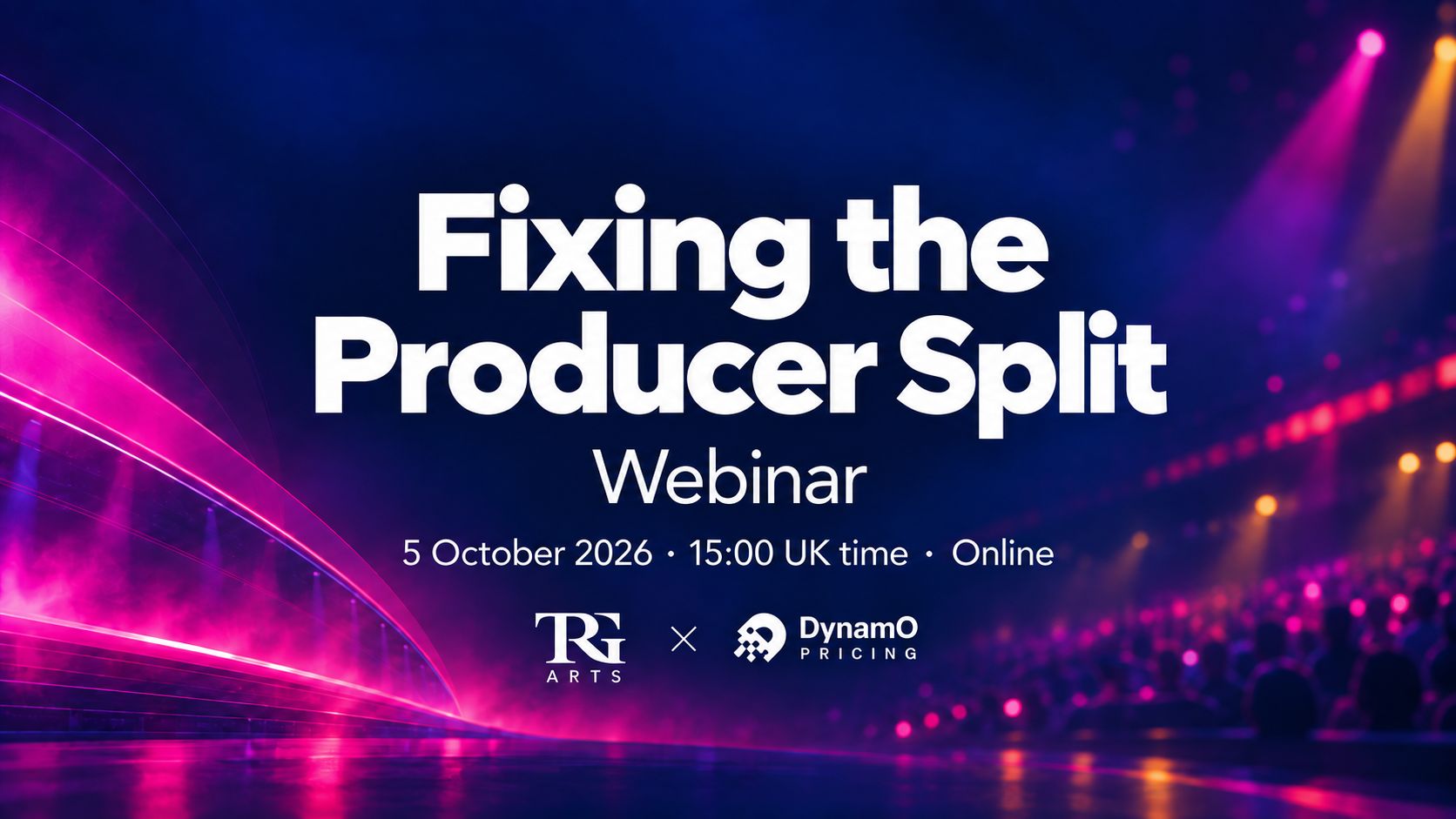
UK theatre venues have carried the financial burden of box office infrastructure, ticketing technology, and marketing - only to steer much of the dynamic upside over to visiting producers.
When most of the extra pound generated by smart pricing flows straight out the door, venues lose the incentive to leverage technology that could improve their entire pricing strategy, not just dynamic pricing. It’s time to break that cycle.
Join DynamO Pricing and TRG Arts for an exclusive commercial working session designed specifically for venue leaders ready to ensure their deals can keep up with the pace of technology.
What we will cover:
Why attend?
This is a direct, commercially focused discussion on how to stop leaving money on the table. You will leave with actionable strategies to take into your next season's programming negotiations.


